Are we pushing Muslims to rebellion and Apostacy?
Frightened of what is happening to humanity, and particularly to us Muslims, and what it is leading up to.
What is happening to us today?
We have seen poverty, and our major fear is that if we do not give our children a professional degree or an established business, they will lag behind. We want the best for them, and so we work extra hard, thinking that we have provided the latest gadgets, food on the table, bigger and bigger houses. Unfortunately, the world is not being run according to Islamic principles, so we have to live according to its economic rules. These in turn are flouted by those of who can - Muslim or non-Muslim. We cater to our children's whims, or we discipline them harshly. We look at the world, and think it is money that makes it go round, so we want our children to have money and status. We guide them to secure, well-paying professions, without checking if they are suited to these.
At the same time, we are afraid that the children, particularly afraid that the girls, will go astray, and have relationships or occupations or marriages that are not Islamic. We are not that worried much about our sons doing unIslamic things. Where it comes to our women, we are extra conservative. What we tolerate from our brothers and sons, we cannot see in our sisters or daughters. When they ask why can we not do what this person is doing, we say because he/she is a non-Muslim. And if a Muslim does it, we say he is a bad example. He will end up in Hell, and we want to go to Heaven.
Unfortunately we too sometimes, if not often, set bad examples. We tell lies. We cut corners. We engage in interest-bearing activities. Some of us take alcohol.
In the teen years, we notice a change in our children's behaviour that is bewildering to us. They are rebellious. They experiment with bad taste. At college they prefer to go away from home. Many start living a double life - drink, dance and sex at school, Salah and obedience at home. Those who cannot live a double life, feel miserable, rebel, and leave home to live the life they want.
This is in the West, where despite economic meltdowns, there is a safety net, and the jobs are still many orders of magnitude more than in the East.
But quite often we shut the doors on women who sin in our eyes. Deprived of community contact and support, they seek comfort among non-Muslims, and eventually become apostates.
Wouldn't we be held accountable for this?
I saw this when I reviewed The Spy Princess. The entire Universal Sufi Movement in the West had gone apostate, but there was no dialogue with it from Muslims.
Researching for my novel, I came across a model who did not say she was giving up Islam, but her actions were contrary to Islam, and she admitted it as such. She was shunned by the community, and pushed away, so that eventually she married a Jew, and lives a life with Jewish friends. What chance is there of her or her children coming back to Islam. Had her Muslim friends maintained a cordial relationship with her, she may have had a chance to come back to Islam.
There must be many more in society who had been similarly made outcast by our community, and they will, on the Day of Judgement, accuse us of abandoning them. They will be right.
In the Muslim countries too this apostacy has also existed. However, people eventually did come back to Islam, with time. Very few would die apostate. This is now changing, too.
There is a saying of the Prophet something to the effect that a time will come when a person will be momin in the morning, but kaafir in the evening; and momin in the evening, but kaafir in the morning. We see this happening today. Fitnahs are coming rapidly line drops of rain.
-----------------------------------------------------------------------------------
jazakallah khair A good summary of many of our problems and a good reminder. How much are we to blame for others' choices? We all make choices that affect others. They're responsible for their actions and we're responsible for ours. If each person lived up to their end of the bargain the system would work. unfortunately seems like neither side is.
Sunday, October 26, 2008
Wouldn't we be held accountable for this?
Sunday, October 19, 2008
Comments on Noor
Noor's character and qualities:
i. Unselfish:: More unselfish persons may have existed, but are hard to come by.
ii. Truthful: She could not tell a lie.
iii. Kind and Loving.
iv. Polite: even in suffering
v. Stubborn:
vi. Loyal:
vii. Patient:
viii. Ingenious: She devised ways of escape from the Gestapo, and succeeded nearly in all three attempts she made.
ix. Perseverence
Among her accomplishments can be added her language skills: English, French, German, Spanish, Roman Urdu & Hindi
musician, poet, writer of children's stories, radio broadcaster
and master spy who saved the lives of 30 downed pilots, evaded the Gestapo for months when the life expentancy of spies was six weeks, became and maintained the sole lonk between six rsistance groups and London, did not break under extreme torture and degradation, maintained a dignified attitude throughout
etc.
Why did she volunteer to become a spy?
She had no attachment to the British Empire. She could have just gone to Britain, and lived there until France was liberated, then come back and resume her career as a writer, musician and narrator os stories on the radio.
If she did have to offer her services to the War Office, why did she volunteer to work as a spy. It was such a risky (almost certain torture and death) to do.
She was not French, although she had lived, been educated and worked there. So French nationalism was not a factor for her. She probably had a large number of friends, and was sympathetic to their cause.
Did she want to be remembered as an extraordinary woman? Was being read about by men a driving factor in what she had set out to do? Did her "fiancé" at the War Office indicate he liked "extraordinary women"?
Or was it the Nazi atrocities, which made her determined to put fight with the Nazis before anything else. The Vichy government of occupied France had started handing over Jewish children to the Nazis.
We can say with certainty that she was selfless, and had volunteered purely to fight Fascism.
She perhaps saw herself as an Internationalist. Born in Moscow to an Indian Muslim father, and an American white mother, raised in a circle of religious tolerance, fluent in English through mother tongue, French through early schooling and living most of her life in Paris, Spanish and German through language school, Urdu and Hindi (although not the script). She wrote Urdu and Hindi poetry in Roman script. She was also an anti-Imperialist.
Did she achieve what she had set out to do?
She never lied. She just went quiet. No matter what torture or humiliation she was made to suffer, she did not reveal any information regarding her contacts or her mission. She helped recover Allied pilots, and was the sole contact between the Resistance and the British for the few months she was operative, rendering excellent service. She thought men are impressed by extraordinary women, about whom men read. She is being so remembered, and men are reading of her life, and marveling at her valor.
Has the world become a better place?
Yes, the Nazi atrocities have gone, but the world retains their mentality. You only have to look at the behaviour of Empires towards their colonies. Then see the conduct of the cold war in the West, and hot wars in the developing countries. & finally you can look at the conduct of the Soviets in Afghanistan, of the US in Afghanistan and Iraq, of India in Kashmir, and of Israel in Palestine.
Was she a Muslim?
In her book Shribani Basu calls her a Muslim in several places.
Did she say the shahada? Did she pray the Salah? Did she fast in Ramadan? Did she read the Quran? Did she observe the dos and don'ts of Islam?
Her father, whose faith she had embraced, wrote that the rites are meaningless. In the Movement or Order he founded, no one had to leave his/hers faith/religion. There were no dietary or dress restrictions. It was left to the individual.
She wrote poetry in English, French, Urdu and Hindi. She was fluent in German and Spanish. She wrote Urdu in the Roman script, but expressed a desire to learn the script. No mention if she ever did. She learnt Hindi and expressed her intention to learn the Devnagiri script, so that she could learn Sanskrit.
She read the Koran and the Bible and she often read the Bhagwat Geeta for comfort.
If she hadn't learnt the Urdu script, it is unlikely she would have learnt the Arabic one, so it is safe to assume she read the translation of the meanings the Quran, not the Quran as originally revealed in Arabic.
From what I have read so far, nothing about Islamic beliefs or practices has been mentioned in any of the write-ups, or parts of the book about her that I have read. Indian newspapers do refer to her as a Muslim, but offer no evidence, except the name, and her father going to the West as a Sufi Pir. That he founded a new religion, is conveniently overlooked.
The Universal Sufism Movement broke up into loosely connected parts, controlled variously by Noor's Uncles and their inheritors. The main did pass again into the hands of Inayat Khan's son, who was Noor's closest person in the family, and perhaps shared her outlook on life and the Hereafter. He did not profess or practice Islam. His son Zia, however, is said to be a practicing Muslim.
She started out in a household where Indian traditions were observed, but not necessarily Islamic. The children are upset when someone tells them Santa Claus does not exist. They run to their father who says that whatever is thought of or talked about, exists in some other plane.
At the Music Institute, she got engaged to a Jewish fellow student from a working class background, without telling her family first, let alone seeking permission from them. She got him to join her deceased father's Sufi Movement, where her family and the Sufi Order discovered they were engaged to be married. They opposed it, and although she saw substance in their arguments, she hoped they would come around. Her fiancé's demands created conflicts within her which made her ill, and finally she had to call off the engagement.
Next she is reported to be sympathetic to a proposal for marriage previously made to her by a young Dutch follower of the Sufi Movement. A proposal of marriage from an Indian cousin (presumed Muslim, also from a Sufi background, but Indian Suf, not the Sufi Movement follower) is also almost finalised, but falls through.
When she started working, or maybe at school, she discarded the Indian dress and put on a more Western one. She cut her hair.
There is no mention of Islam's dietary restrictions observed by people in her father's Sufi Movement. Did her family did not observe any?
There is no mention of observing the Salah, fasting or the like. The religious services at the Order consisted of his lectures based on Oriental religions, and reading of texts from many religions' holy books.
When she joined the WAAF, she gave her name as Nora Baker, and her religion as Church of England. It was to avoid unnecessary complications, but then she joined Church of England services with the rest of the recruits.
When being interviewed and trained for intelligence work by the master codeman Leo Marks, she is said to have remarked that she would like to use two pigs (in a Buddhist tale) for imagining what Matks had told her to do with monkeys. She had no abhorrence then for pigs, as Muslims have.
Next we learn that she announced her engagement to a person at the War Office. Nothing more is mentioned about the man. Since Muslims were scarce in England, it is safe to assume that her fiancé was not a Muslim.
Finally, some of her colleagues say she and Antelme (a fellow SOS agent) became lovers when they were on the run from the Gestapo, and that they planned marriage on their return to Britain). Maybe, maybe not, but in any case, Antelme was not a Muslim.
Her sister Claire (Khairun-Nisa) married a Mr. Harper. She and her son, David Harper were interviewed by BBC program Timeline program, broadcast as "The Spy Princess" in 2006. This was in connection with Noor's life.
All in all, the movement and the family have been moving away from Islam to an amalgam of Faiths.
So Noor had access to the Quran, yet preferred not to observe the do's and don’t's, and considered all religions at par, all Gods as manifestations of the same. Jesus, to her, must have been God's face too, as her Order is a proponent of wahdatul wujood, the Oneness of Existence - all existence is part of God.
Shirk, as we see it.
Friday, October 17, 2008
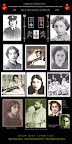
Noor Inayat Khan: courage & self-sacrifice
I wrote this on Eid night.
October 1st, 2008 Chaand Raat of Eid-ul-Fitr.
I won't be writing about Eid day. It will be tonight- Chand Raat, Eid night.
It is Eid night here, and I cannot sleep …
My son is coming on Eid day in the evening, and I will be glad to see him and the bahu (d-i-L), but that is not the reason for loss of sleep.
Previously I lost sleep when I saw on TV, the US bombing of a civilian shelter in Baghdad with one of its smart missiles. What the rescue workers took out were charred bodies of women and children.
This continues to be the US mode of operation in Afghanistan and Pakistan as well.
The videos of the Bosnian and Kashmiri suffering also caused me insomnia.
Have you read Spy Princess by Shrabani Basu?
On Monday 29th September, I leafed through this interesting book at a bookstore. Initially I did not want to buy the book because of its price, but the story is so captivating, that I bought it.
I am glad that I did, for it dispelled some of the misconceptions I had developed on the leafing through.
I sat down to write a gist of the book with some comments of my own, but I cannot leave much out, and I feel very, very depressed as I go through this story.
Shrabani's narration is the most accurate so far, as it is the only one that also draws on classified War Office papers that were declassified in 2003.
Nur-un-Nisa (Noor) Inayat Khan, alias Nora Baker alias Madeleine (1914-1944), was the eldest child of Pir Inayat Khan. She was the grand-daughter of Tipu Sultan's great-great grand-daughter. Tipu was the last Muslim king of Mysore, who was martyred when fighting British soldiers of the East India Company. Noor was born at Moscow on 1st Jan 1914 to her American mother Ora Ray Baker, who had met her father when he visited the United States. Ora was a distant cousin of the woman who was the founder of the Christian Science movement. She was under age, and her guardian was in favor of her marrying Inayat, so she waited until she ocame of age. Inayat had, meanwhile had came to Europe. Ora joined him, and changed her name to Sharda Amina Begum.
Noor's father, Inayat Khan had started out as a Sufi Chishti Shaykh, who had been sent to the West for spreading Islam. Discovering prejudice against Islam, he had instead formed a new Sufi Order Universal Sufism, that regarded all religions as from God. Islam teaches that, too, but it says that the other religions are now corrupted versions of the original message. Inayat preached wahadatul wujood . In special prayer sessions, extracts from texts of holy books of different religions were read). The Movement has its own Temples, just like the Bahais. Its development, infighting for control and breakup into subsidiary Orders that are still joined together, are interesting studies as well, but we will focus on Noor here.
Inayat was a successful music teacher and performer (together with his brothers) in Moscow at the time of Noor's birth. He had become friends with Leo Tolstoy's son. WW-I began on 28th July 1914, Noor's family moved to London in August of the same year, and then to Paris in 1920.
At school, the Inayat children had to bear with considerable teasing, due to not being fluent in French (they spoke English at home), and being darker colored than their peers. Noor bore all this with good humor and a smile. She learnt to keep her thoughts to herself, and yet won friends by being sweet and helpful under all that teasing.
If Inayat were a Muslim, Sufi or not, he may have taught Noor and his other children how to gain inner strength from meditation on the Almighty. The memebrs of the Sufi Movement do Dhikr, remembrance of Allah by reciting Allah's names in original Arabic.
Noor's father visited India in 1927, was shown around Nizamuddin Auliya's dargah, became seriously ill and died there, then buried in the dargah. Her mother, overcome with grief, became ill and indisposed for the rest of her life. So Noor had to take care of her younger siblings from the age of 13. She would compose poems, in English, French and Urdu (she wrote them in Roman Urdu, as she did not know the Urdu script. She made cards by hand and illustrated them delicately with flowers and drawings of animals. She loved her family. Who does not, but her devotion and love were extraordinary.
Noor had to attend school herself, and look after the household at the same time, on an allowance that can best be described as frugal.
She joined Ecole Normal de Musique for studying Music in 1931, and fell in love with a fellow Jewish student from a working class background. They became engaged to be married. This was an unfortunate choice, as he was grossly demanding and overbearing. He was rejected by her family and its circle of friends. She, nevertheless, persevered with the engagement in the hope the family would come round. Her family, however, saw that it wasn't love but her nature of wanting to help those with handicaps that was responsible for this liaison.
She had absorbed her father's thesis (actually, an old one), that all religions led to the same Almighty, and hence got close to that fellow student. She wanted to end the engagement earlier, but he threatened her with suicide if she did not marry him. So she kept the relationship alive. But the conflict within her made her ill, and eventually she saw that she had to break the engagement.
Noor studied child psychology at Sorbonne University. Later she studied languages, and became proficient in German and Spanish. However, upon graduation, she could not apply for a job as her family was Royalty, albeit on hard times. Family traditions dictated that women got married and stayed home. She couldn't take a job, period.
A very eligible young man in the same Sufi Order, had been paying her attention for marriage, but she had not considered it because she had already been engaged. He went to India on a lucrative post, and her brother convinced her that they should follow him and she should marry him. The problem was they had no money. They went to his aunt who had helped the Order in the past. She was glad of their plans but failed to realise they needed financial help, and they were too shy to mention it, so that possibility petered out.
She started writing stories for children for Le Figaro in November 1938. She was asked to write a book for children into French. She chose Buddhist tales, and her book "20 Jataka tales" was published in the summer of 1939. She was also asked to read her stories on French radio for children's programs. A career as a writer and radio broadcaster for children's programs began to develop. This also gave her a much needed independence from her uncles and other members of the family.
She had previously liked to wear Indian dresses, but as she gained this independence, she increasingly became more European in her dress and manners. Her sister even changed her name to Claire from Khairun-Nisa, in order to fit in with the society they lived in. Amina Begum did not like this, as she had adopted the Indian dress, and was never seen without her dupatta or hijab, but tolerance was the name of the game in this Sufi order, so she kept her peace.
Noor perhaps saw herself as an Internationalist. Born in Moscow to an Indian Muslim father, and an American white mother, raised in a circle of religious tolerance, fluent in English through mother tongue, French through early schooling and living most of her life in Paris, Spanish and German through language school, Urdu and Hindi (although not the script). She wrote Urdu and Hindi poetry in Roman script. She was also an anti-Imperialist.
When the Nazis occupied France, the family decided to do whatever they could to fight them. It wasn't their war, but they could not see the Nazis deport Jews to concentration camps, and sit silently.
The mother and children, except the youngest son Hidayat, moved to London on 5th June 1940. Hidayat was married and went to the South of France for spying on the Germans. Noor and Vilayat went to the War Office in London. On 14th June 1942, Noor's "The Fairy and the Hare" was broadcast on BBC Radio's "Children's "Hour."
Noor attended RAF Commission's interview on 28th August 1942. She had a British passport, as her father was Indian, and India was the jewel in the British crown. Vilayat was rejected for the RAF, but accepted in the Royal Navy after getting a maritime certificate. Noor was accepted in the WAAF. Noor, after seeing the problems faced by the recruiting clerk in spelling Vilayat (he had entered Vialayat as Vic, and without asking his religion as Church of England), told the clerk her name was Nora Baker, and religion Church of England. Hence when living as a trainee, she attended CoE services with the other girls. To all intents and purposes, she became Nora Baker from now on in her outwardly appearance and behavior. According to her father's teachings the outward practices did not matter.
She spent a few months in WAAF, before the SOE sent for her to be interviewed in November 1942. They had been looking for recruits. Someone noticed the comment "excellent French" after her name. In her interview, she said she would remain loyal to the British as long as the war was on, but then she would return to India to fight for India's Independence. This shows her political awareness, commitment and a rare maturity. Most interviewers and testers thought she would break down under torture, as her build was slight, and her comment about India indicated an excess of emotion. She also, couldn’t lie, and what use is an agent who cannot lie to the enemy.
She was very good with the wireless, so the SOE's F-section chief wanted her. He brought her to the master codesman Leo Marks for special tuition and advice. Marks thought she was too refined and loving. "Oh, Noor, what are you doing in the SOE?", he thought. He wanted her to fail the tests, so she would stay in safer Britain, rather than behind enemy lines. However, she was the best of wireless operators he had trained and tested. He, like other interviewers, found that she could not lie, and was a little careless. He gave her advice on care, which she heeded to her last. He told her to be immaculate in her filing, which she did, and also kept copies of messages she sent, as she thought she had been told to maintain these in a file, taking the literal meaning of "filing" to her heart. As for lying, try as she might, she just couldn't. Marks told her if she couldn't lie, she would jeopardize not only herself, her mission, but also the lives of all those in contact with her or known to her in France. She thought for a while and said: "what if I say nothing".
When she came back from her incomplete training, she had a smirk on her face. she told her mother she had a job with the WAAF (Women's auxiliary Air Force) that might entail her going abroad. She also mentioned that she had become engaged to someone at the War Office, but she gave no further information. She had been so unsuccessful in her romances, that she did not want to tempt fate by telling much. No one discovered who the mysterious fiancé was, and he never came forward.
Noor remained unmarried until her death.
This is not to say she did not have a love life.
In all probability, she had sex with her fiancés - the Jewish student and the unknown man at the War Office. Antelme, a British citizen of Franco-Mauritian descent, interacted with her as with others. Her colleagues are also sure she had sex with her fellow spy, France Antelme. The details of the colleagues and their statements are not given in the book "Spy Princess". The two were even reported to be planning marriage after returning to Britain.
The lady who rented her the apartment however, thought Antelme only had a paternal interest in her. This is unlikely, Antelme was in his forties, and Noor was thirty. He may have thought initially he was showing a paternal interest, Although Noor had her fiancé back in England, and Antelme already had a French girlfriend, they had been placed together in very trying circumstances. It is possible that their mutual liking and predicament may have turned into seeking solace in sex, and exploring the possibility of spending the rest of their lives together. In such times, the existence of fiancés back home is irrelevant. All the author Shriabni says lamely is something to the effect that in the presence of fiancés back home, they could not have discussed mutual marriage plans.
Did Noor say Salah: in all probability,: no.
Did she observe the dietary rules of Islam: no
The SOE was very short of wireless field personnel, so she was sent into the field before her training was complete. When finally saying goodbye to her trainer Vera Atkins, she pointed at a book on the shelf about "Extraordinary women", remarking "men like reading about extraordinary women".
She had signed the Official Secrets Act on February 1943, and she, the first woman wireless operator to be sent abroad, was dropped in France on 16/17 June, 1943.
Her group, the Physicians Group or Prosper, had already been compromised before she joined. Most of its members were arrested within ten days of her arrival back in France. She was the only free wireless operator left in her circle, and she frantically sent information (20 messages) to London while dodging the Germans. Once she was nearly caught by two German soldiers with her radio but she said it was a home cine equipment, and they believed her.
Unfortunately for them, Antelme already had a French girlfriend in the same Resistance circle as her. Naturally the jilted girlfriend resented losing Antelme's attentions to Noor, and became jealous of her.
When the group had been broken up by the Germans and most of her circle arrested, the British recalled their operators in that circle, as it was now very dangerous to operate there. Antelme went back. Noor refused. She (the only radio operator left in the field) was the only existing contact with the British, and thus the lifeline of the French Resistance groups. So she stayed and continued to relay important messages which saved more than 30 (thirty) Allied airmen's lives who had been shot down over France.
Not surprisingly, she was betrayed by Antelme's ex-girlfriend for 100,000 Francs.
If I were a spy chief, I would emphasize that my agents avoid liaisons like these, for the risk of treachery due to jealousy is very great.
Noor was arrested by the Gestapo on 13th Septemvber 1943, and interrogated over the next month at the Paris HQ of the Gestapo.
She was pretty, petite, and delicate. Her zeal for Indian freedom was misinterpreted by her interviewers as her being too emotional. They felt she was not suitable for a spying job, and would break down under torture. However, her French was excellent. Her skin coloue, not white, not blach, but café a la crème, made her look like a Creole, and that wouldn't raise any suspicions. She was also very good with the wireless, and the Chief selector was very impressed with her. She was sent as a spy.
Under torture or psychological blackmail, she did not break down, and never revealed anything. This was testified by her prison officials later at a trial. Her interrogators were equally impressed with her integrity, perseverance, tolerance and tenacity.
She made one mistake, though, and that should be thought of as perfect attachment to what she had been told, or rather what she understood she had been told. She had kept a record of all the messages she had sent. It was against the rules of espionage. This was due to unclear instructions. She was told to be immaculate in her filing. What this meant was that she should not make mistakes in filing a report, and should be on time. That she was, but she also took it literally in maintaining a complete and accurate file of all messages she had sent. She was told by a visiting fellow agent that this was dangerous, and she should destroy that notebook containing her messages. She, however, continued to act according to what she had understood from Marks, the master cryptographer for the SOE. This misunderstanding allowed the Germans to break her code, and to relay false information that resulted in the sending and capture of more agents, including Antelme and two others, one a woman, who would die with Noor. All three were among the best spies of the British.
The concerned British authorities are to be blamed, They knew that the messages lacked a confirmation signal. Furthermore they knew that the resistance ring their agents were to be dropped into, had fallen in German hands, and was being operated by them. In fact, despite this certain knowledge, Alterme volunteered to go over to France. Maybe he was missing Noor and was feeling guilty at leaving her alone in danger. As mentioned above he, too, was captured, tortured, and executed. He too, did not divulge any information under torture.
There is evidence that the British deliberately sacrificed their agents in the field to keep the Germans off the trail of more important plans, including the Normandy landings. That they did bungle up, is without any doubt, for had they paid heed to the hidden tests of genuine transmissions, they would have understood that Noor had been captured. They also sent Noor unnecessarily to meet the Gestapo agents, who got a good look at her, and thus agent Madeleine could be recognised anywhere,
Noor even managed to escape three times. The first one on the very day she was captured where she tried to escape through the window of the lavatory she had said she was allowed to take a bath in. The second was when she persuaded two male prisoners to join her in an attempt of the building she was being kept in, but was recaptured due to heightened security through removing the bars on the skylights in their rooms. They might have succeeded had British airplanes not started bombardment of the locality. After They were asked to sign a declaration that she wouldn't try to escape again. She and another prisoner refused. Both were sent to German prisons. She to Pforzheim on 13th October 1943.
Noor was singled out for special treatment, maybe because her skin color was darker. Maybe because she did not bow to Nazi pressure, and replied with dignity to abuses. She fought her captors fiercely. She was described as dangerous and kept manacled to the wall and in solitary confinement for most of her time in captivity. Both of her legs were bound together by chains, both hands similarly, and then, hands and feet tied together by another chain, so that she cannot stand up. And what is more, she wasn't even free to move with her chains. She could not go to the toilet. She could not clean or eat herself. A cleaning woman came to clean her and her cell. Imagine if one has to answer the call of nature in the semi-nude clothing she was wearing, and in the same place she was chained to, and to put up with the filth until the cleaning woman came, and one's indignation and anger is sky high. Note too, that this was a woman just thirty. She had menstrual periods, which means involuntary secretions and smelly flows from the body from days every month. She must also have been taunted on her nudity, her smelly body, her skin colour. How she endured all this degradation, is beyond imagination, but endure she did, with her head held high, and without giving the Nazis any information.
She was allowed to wear very scanty clothes, which were insufficient to protect against the cold.
When eventually she was given some exercise, it was also in isolation, and she was taken every day an the afternoon for no more than 45 minutes. She used this time to go by doing gymnastic exercises. Her soft nature can be seen in that she profusely thanked the officer who let her out for this brief respite from the chains, although he was only doing what he was told to do.
Even the scant clothes she could wear, were removed to degrade her further, and she was left naked. She found a sackcloth, with which to hide her nudity, and to come out for a walk at the appointed time. She was given one bowl of potato peel soup per day. She was severely tortured by beatings. She was abused verbally and maybe sexually. All this was to break her spirit and to keep her weak. She was beaten, stripped naked, and had to hide her body in a sack for exercise. Once the soldiers heard some other female prisoners go by her cell singing the news of Allied victories to her. They were told off, but Noor was taken to the basement and beaten harshly (maybe even raped) . Her cries could be heard by the other prisoners. When alone in her cell, she gave vent to her anger and pain by sobbing, which could be heard by the other prisoners, but they could do nothing to ease her suffering.
Four women, Eliane Plewman, Madeleine Damerment, Yolande Beekman and Nora Baker (Noor) were discharged from the Pforzheim prison on 11th September, and transferred to Dachau and lodged in separate cells. On the night of 12th September 1944, Pirzadi Noor Inayat Khan was given a specially hard time: "with full works", as described by some. She was kicked by the German soldiers with their heavy boots, raped repeatedly, and in the morning of the 13th, when she lay in a bloody mess, was told to kneel as she was going to be shot in the head. Her last word was "liberté". The other three girls were simply shot in the head. They, mercifully, did not receive the "full treatment". Bodies of the four women agents were then cremated.
The Nazis had broken her body, but not her spirit.
A plaque now marks her resting place at Dachau. Seven months later Dachau was liberated, but it was too late. She was thirty years and nine months old when she was murdered.
The French celebrate her as a national heroine. Posthumously, the French awarded her the Croix de Guerre. She was given the George Cross and made an MBE by Britain.
Do awards in this world matter?
Some of her contemporaries described her as idealist, dreamy, clairvoyant The dreamy bit may be due to her idealism, which turns out to be practical. We see that she looks after her siblings when she is herself a child and her mother is in ill-health. She uses her knowledge of child psychology by writing stories for children, and by doing radio shows for them. She shows her love for humanity by joining the War as a spy against the Nazis. That courage in putting her life at stake, of braving the possibility of torture and early death, is breathtaking.
It is Eid night here, and I cannot sleep …
Then a prayer comes to my heart, not to my lips. I seldom vocalize my prayers.
"O Allah! You are free from all blemish. Whatever happened, happened with your knowledge. O Allah! cleanse Noor of all sins, forgive her, give her permanent abode in Jannat-ul-Firdaws."
Friday, April 4, 2008
What the classroom doesn't teach US students?
adapted from Howard Zinn "Empire or Humanity?"
With an occupying army waging war in Iraq and Afghanistan, with military bases and corporate bullying in every part of the world, there is no question of the existence of an American Empire. The once fervent denials have turned into a boastful, unashamed embrace of the idea.
However, the very idea that the United States was and is an empire did not occur to US students and citizens - even those questioning the purity of the "Good War," even those horrified by Hiroshima and Nagasaki, even those rethinking the bombing of human dwellings across the world. Oh! They are conscious of the British Empire and other imperial powers of Europe, but the United States is not seen in the same way. Courses in U.S. history include a chapter called "The Age of Imperialism." It refers to the Spanish-American War of 1898 and the conquest of the Philippines that followed from which it seems that American imperialism lasted only a relatively few years. There is no overarching view of U.S. expansion that might lead to the idea of a more far-ranging empire – or period of "imperialism."
The classroom map (labeled "Western Expansion") presents the march across the continent as a natural, almost biological phenomenon. Huge acquisition of land called "The Louisiana Purchase" hints at nothing but vacant land acquired. There is no sense that this territory had been occupied by hundreds of Indian tribes which would have to be annihilated or forced from their homes – ethnic cleansing – so that whites could settle the land, and later railroads could crisscross it, presaging "civilization" and its brutal discontents.
Neither the discussions of "Jacksonian democracy" in history courses, nor the popular book by Arthur Schlesinger Jr., The Age of Jackson, tell about the "Trail of Tears," the deadly forced march of "the five civilized tribes" westward from Georgia and Alabama across the Mississippi, leaving 4,000 dead in their wake. No treatment of the Civil War mentions the Sand Creek massacre of hundreds of Indian villagers in Colorado just as "emancipation" was proclaimed for black people by Lincoln's administration.
Classroom maps also have a section to the south and west labeled "Mexican Cession." - a handy euphemism for the aggressive war against Mexico in 1846 in which the United States seized half of that country's land, gaining California and the great Southwest. The term "Manifest Destiny," used at that time, soon of course became more universal. On the eve of the Spanish-American War in 1898, the Washington Post saw beyond Cuba: "We are face to face with a strange destiny. The taste of Empire is in the mouth of the people even as the taste of blood in the jungle."
The violence across the continent, and even the invasion of Cuba, are presented as being within a natural sphere of U.S. interest. After all, hadn't the Monroe Doctrine of 1823 declared the Western Hemisphere to be under US protection? But with hardly a pause after Cuba came the invasion of the Philippines, halfway around the world. The word "imperialism" now seemed a fitting one for U.S. actions. Indeed, that long, cruel war – treated quickly and superficially in the history books – gave rise to an Anti-Imperialist League, in which William James and Mark Twain were leading figures. This was not something you learn in a US university either.
Reading outside the classroom, however, you can began to fit the pieces of history into a larger mosaic. What at first seems like a purely passive foreign policy in the decade leading up to the First World War now fits as a succession of violent interventions: the seizure of the Panama Canal zone from Colombia, a naval bombardment of the Mexican coast, the dispatch of the Marines to almost every country in Central America, occupying armies sent to Haiti and the Dominican Republic. As the much-decorated Gen. Smedley Butler, who participated in many of those interventions, wrote later: "I was an errand boy for Wall Street."
In the years after World War II, the United States was becoming not just another imperial power, but the world's leading superpower. Determined to maintain and expand its monopoly on nuclear weapons, it was taking over remote islands in the Pacific, forcing the inhabitants to leave, and turning the islands into deadly playgrounds for more atomic tests.
In his memoir, No Place to Hide, Dr. David Bradley, who monitored radiation in those tests, described what was left behind as the testing teams went home: "[R]adioactivity, contamination, the wrecked island of Bikini and its sad-eyed patient exiles."
When the war in Korea began in 1950, nothing in US classes showed the real reasons for American policy in Asia. I. F. Stone's was among the very few journalists who questioned the official justification for sending an army to Korea. It was not the invasion of South Korea by the North that prompted U.S. intervention, but the desire of the United States to have a firm foothold on the continent of Asia, especially when the Communists were in power in China.
Years later, as the covert intervention in Vietnam grew into a massive and brutal military operation, the imperial designs of the United States become clearer to the discerning student, maybe due to US body bags or the fear of being drafted.
In 1967, Zinn wrote a little book called Vietnam: The Logic of Withdrawal. When you read the hundreds of pages of the Pentagon Papers by Daniel Ellsberg, what jumps out are the secret memos from the National Security Council. Explaining the U.S. interest in Southeast Asia, they spoke bluntly of the country's motives as a quest for "tin, rubber, oil."
Neither the desertions of soldiers in the Mexican War, nor the draft riots of the Civil War, nor the anti-imperialist groups at the turn of the century, nor the strong opposition to World War I – indeed no antiwar movement in the history of the US reached the scale of the opposition to the war in Vietnam. Part of that opposition rested on an understanding that more than Vietnam was at stake, that the brutal war in that tiny country was part of a grander imperial design.
Various interventions following the U.S. defeat in Vietnam reflect the desperate need of the still-reigning superpower – even after the fall of its powerful rival, the Soviet Union – to establish its dominance everywhere. Hence the invasion of Grenada in 1982, the bombing assault on Panama in 1989, the first Gulf war of 1991. Was George Bush Sr. heartsick over Saddam Hussein's seizure of Kuwait, or was he using that event as an opportunity to move U.S. power firmly into the coveted oil region of the Middle East? Given the history of the United States, given its obsession with Middle Eastern oil dating from Franklin Roosevelt's 1945 deal with King Abdul Aziz of Saudi Arabia, and the CIA's overthrow of the democratic Mossadegh government in Iran in 1953, it is not hard to decide that question.
If you believe that 9/11 was conceived and perpetuated y Arabs, it follows (as per the official 9/11 Commission ), that this attack derived from fierce hatred of U.S. expansion in the Middle East and elsewhere. Even before that event, the Defense Department acknowledged, according to Chalmers Johnson's book The Sorrows of Empire, the existence of more than 700 American military bases outside of the United States.
Since that date, with the initiation of a "war on terrorism," many more bases have been established or expanded: in Kyrgyzstan, Afghanistan, the desert of Qatar, the Gulf of Oman, the Horn of Africa, and wherever else a compliant nation could be bribed or coerced.
When bombing cities in Germany, Hungary, Czechoslovakia, and France in the Second World War, the moral justification was so simple and clear as to be beyond discussion: The US was saving the world from the evil of fascism. In reality, though, it was an imperialist war. Both sides were motivated by ambitions of control and conquest.
In wars, there is always a difference between the motives of the soldiers and the motives of the political leaders who send them into battle. The motive, presented to the soldiers and the citizenry, is innocent of imperial ambition. It is to help defeat fascism and create a more decent world, free of aggression, militarism, and racism.
The motive of the U.S. establishment, is of a different nature. It was described early in 1941 by Henry Luce, multi-millionaire owner of Time, Life, and Fortune magazines, as the coming of "The American Century." The time had arrived, he said, for the United States "to exert upon the world the full impact of our influence, for such purposes as we see fit, and by such means as we see fit."
You can hardly ask for a more candid, blunter declaration of imperial design. It has been echoed in recent years by the intellectual handmaidens of the Bush administration, but with assurances that the motive of this "influence" is benign, that the "purposes" – whether in Luce's formulation or more recent ones – are noble, that this is an "imperialism lite." As George Bush said in his second inaugural address: "Spreading liberty around the world… is the calling of our time." The New York Times called that speech "striking for its idealism."
The American Empire has always been a bipartisan project – Democrats and Republicans have taken turns extending it, extolling it, justifying it. President Woodrow Wilson told graduates of the Naval Academy in 1914 (the year he bombarded Mexico) that the U.S. used "her Navy and her Army … as the instruments of civilization, not as the instruments of aggression." And Bill Clinton, in 1992, told West Point graduates: "The values you learned here … will be able to spread throughout the country and throughout the world."
For people all over the world, those claims sooner or later are revealed to be false. The rhetoric, often persuasive on first hearing, soon becomes overwhelmed by horrors that can no longer be concealed: the bloody corpses of Iraq, the torn limbs of American GIs, the millions of families driven from their homes – in the Middle East and in the Mississippi Delta.
The justifications for empire, embedded in US culture, are that war is necessary for security, that expansion is fundamental to civilization, Can these false justifications begin to lose their hold on minds of US citizens? Is it possible that a point in history has been reached when the US is ready to embrace a new way of living in the world, expanding not military power, but humanity?
Howard Zinn is the author of A People's History of the United States and Voices of a People's History of the United States, now being filmed for a major television documentary. His newest book is A People's History of American Empire, the story of America in the world, told in comics form, with Mike Konopacki and Paul Buhle in the American Empire Project book series. An animated video adapted from this essay with visuals from the comic book and voice-over by Viggo Mortensen, as well as a section of the book on Zinn's early life, can be viewed by clicking here. Zinn's Web site is HowardZinn.org.
Thursday, April 3, 2008


Saturday, March 29, 2008
Insoluble problems, and the cure
Why do we suffer from almost insoluble problems, and what is the cure?
This is in the light of my experiences and something of the deen that I remember.
· What happens is almost always due to one’s own mistakes. E.g. we say something that becomes a wish for hard times, or at least expresses our readiness to brave such times. I give here an example from my life. I was not given a directorship, and I said I don’t care, I don’t need or want it. Result: I never got it at my place of work. Similarly I was denied promotion many times, in the initial stages, when I was bypassed for promotion, I said haughtily: “So what, I do not care. I have fifteen years before I retire, I can wait.” Result: I got my promotion just before retirement. I was reminded of this statement of mine when I retired, and I had never given a thought to what I had said.
So it was for health, for housing, for anything that I suffered from, or was not able to get, I expressed disdain. Result: I either did not get it, or got is very late in life. And this is true of matters pertaining to the deen, too. When I came back to Pakistan, I said I would Islamise my life gradually. It has been very, very slow. Result: Despite my age, I have a very long way to go compared to others.
A friend’s wife had a stroke of partial paralysis, and was hospitalized. Whe we visited her, she confided that she had been praying that whatever punishment she was likely to get in the Hereafter, she wished to get it in this world. I told her this was precisely what a Shahabi had wished, and became severely ill. The Prophet :swas: visited him and told him something like: Subhanallah, you do not have the strength to endure such hardship. Why didn’t you ask Allah for forgiveness.”
Moral & suggestion: Do not express disdain. Keep thanking Allah for His fanours, and keep asking Him for more of them. None of us can do without.
And make Istaghfaar - lots of it.